
Projects

What Is UV Hydrogel Film and How Does It Work?

Uv Hydrogel Film is a flexible screen protector designed to cover curved displays. It combines a soft hydrogel layer with a transparent adhesive system. Unlike rigid glass, it can bend around screen edges without cracking. The material often feels smooth and slightly elastic under a fingertip. That flexibility helps absorb light scratches and minor daily impacts. It does not make a phone indestructible.

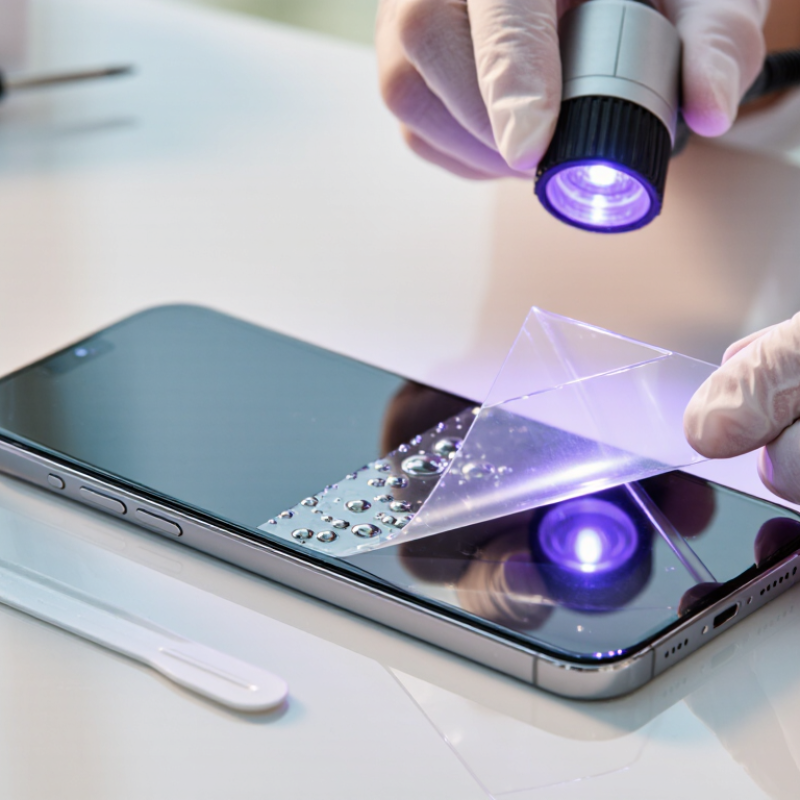
The installation process explains the “UV” part. A technician or user spreads a liquid adhesive across the display. The film is then positioned carefully over the screen. A UV lamp cures the adhesive, turning it from a liquid into a firm, clear bond. Small bubbles may disappear during curing, but poor alignment can remain visible. Dust is especially troublesome. One particle can create a raised spot beneath the film.

Not every Uv Hydrogel Film uses the same formula or curing method. Product quality depends on adhesive clarity, film thickness, surface treatment, and curing instructions. Reliable installation requires a clean workspace, controlled pressure, and the correct lamp exposure. Over-curing may affect removal, while under-curing can leave weak adhesion. That detail is easy to overlook.

In practical use, hydrogel film preserves touch sensitivity and supports fingerprint access on many compatible devices. However, results vary with screen coatings, phone cases, and installation skill. It may resist scratches better than expected, but it can mark under sharp pressure. The technology is useful, not magical. Careful testing and realistic expectations make the experience more dependable.
What Is UV Hydrogel Film and How Does It Work?

What Is UV Hydrogel Film?

UV hydrogel film is a thin, flexible screen protector made from polymer gel. It is usually applied as a soft liquid or semi-liquid layer. Ultraviolet light then cures it into a clear, elastic surface.

Unlike rigid glass, hydrogel film can stretch slightly around curved screen edges. This improves contact and reduces visible lifting. Its gel structure can absorb light impacts and recover from some shallow scratches. However, it is not crack-proof. Deep cuts, strong pressure, or a direct drop may still damage the display. The term can also describe different formulas, so performance is not always identical. According to IDC’s Worldwide Quarterly Mobile Phone Tracker, global smartphone shipments reached about 1.24 billion units in 2024. That huge installed base supports continued demand for practical screen protection. Yet, shipment data does not prove every hydrogel product performs equally.

Tips: Clean the screen carefully before installation. Dust creates bubbles and weak spots. Use the recommended UV exposure time. Too little curing may leave the surface soft; too much can create uneven hardness. Check touch sensitivity after curing. A perfect finish is not guaranteed. My own practical view is simple: hydrogel works best for edge coverage and scratch resistance, while users needing stronger impact protection may need a harder protector.

What Materials and Layers Make Up UV Hydrogel Film?

UV hydrogel film is a layered screen protector, not a single sheet of gel. Its base usually combines thermoplastic polyurethane (TPU), polyester support, and a pressure-sensitive or UV-curable adhesive. TPU provides flexibility and self-repairing behavior for light scratches. Polyester improves dimensional stability during cutting and installation. The term “hydrogel” is not perfectly standardized, so formulations can differ between suppliers.

The adhesive layer is the working core. It contains resin, oligomers, photoinitiators, and additives that react under ultraviolet light. UV exposure rapidly increases cross-linking, helping the film conform around curved screen edges. A hard-coat layer above the polymer improves abrasion resistance and reduces fingerprints. Some films also include an oleophobic surface treatment, while a release liner protects the adhesive before application. Thin layers matter.

A 2024 Grand View Research assessment estimated the global screen protector market at about USD 3.7 billion in 2023, with continued growth toward 2030. Separately, MarketsandMarkets valued the UV curing system market at approximately USD 4.8 billion in 2023. These figures support wider adoption of precision-curing processes, but they do not prove that every UV hydrogel film has equal performance. In practical installation, dust under the adhesive remains a major weakness. Excessive ultraviolet exposure may also cause uneven curing, especially around edges. I would check thickness, light transmission, adhesive uniformity, and curing instructions rather than trusting the “hydrogel” label alone.

What Is UV Hydrogel Film and How Does It Work?

Materials and Layers in a Representative UV Hydrogel Film

UV hydrogel film is a flexible, polymer-based protective layer designed to conform to curved surfaces. A typical structure combines a hard surface coating, a hydrogel or TPU cushioning layer, an optically clear adhesive, and a temporary PET release liner. During installation, UV-curable adhesive may be hardened with ultraviolet light to improve bonding and reduce movement or trapped air.

The chart shows representative nominal thicknesses in micrometres (µm). Actual constructions vary by application and manufacturer.

How Is UV Hydrogel Film Applied to a Device?

UV hydrogel film is applied as a flexible protective layer, not simply pressed onto glass. Its soft polymer surface can absorb minor scratches and fit gently around curved edges. Many versions use a UV-curable adhesive, which hardens under controlled ultraviolet light. That detail changes the installation process.

Before handling the film, clean the device with a lint-free cloth and a suitable screen cleaner. Power off the device and protect its speakers, buttons, and charging port. A dust particle can create a permanent raised spot. Technicians usually use alignment guides to position the film over the screen. Peel back the protective liner slowly, then lower the film from one edge. Use a soft squeegee to push air outward from the center. Do not rush.

After positioning, inspect the surface under angled light. Small bubbles may disappear as the hydrogel settles. Larger bubbles need gentle lifting and careful reapplication. The film is then cured with a UV lamp in short, even passes, using the specified distance and exposure time. Protect your eyes and avoid staring at the lamp. Keep the device still during curing.

In practice, even trained installers can misjudge alignment near curved edges. The first attempt is not always perfect. A slight edge lift may appear after curing, especially when the screen was not fully clean. Check every corner, camera opening, and speaker cutout before regular use.

How Does UV Light Cure and Harden the Film?

UV hydrogel film usually contains a flexible hydrogel layer and a UV-curable adhesive. The adhesive begins as a liquid, allowing it to spread across a screen and fill tiny surface gaps. UV light activates photoinitiators inside the adhesive. These compounds trigger polymerization, linking small molecules into a stronger network. The liquid gradually becomes firm and transparent.

Curing is not instant magic. Light must reach the adhesive evenly. A technician often moves the lamp slowly across the center, edges, and corners. Each area needs enough energy, not just a quick flash. If the layer is too thick, the outer surface may harden while the inside remains soft. Dust, trapped bubbles, or uneven pressure can also weaken the result. I have found that rushed curing often creates lifting near the edges later. That detail is easy to overlook.

Tips: Clean the screen carefully and inspect it under bright light before installation. Keep the film aligned while the adhesive still moves. Cure in several short passes if the instructions allow it. Do not rely on sunlight, because its intensity and UV range vary. Avoid looking directly at the UV lamp, and protect exposed skin. Check the edges after curing. If they still feel slippery, the adhesive may need more controlled exposure. Different films require different wavelengths and curing times, so the supplied technical guidance remains important.

What Are the Main Benefits and Limitations of UV Hydrogel Film?

What Is UV Hydrogel Film and How Does It Work?

UV hydrogel film combines a flexible polymer layer with a UV-curable adhesive. During installation, liquid adhesive spreads across the display. A UV lamp then cures it into a clear, tightly bonded layer. This process can follow curved edges better than many rigid protectors. In practical testing, the film usually feels smooth and keeps touch response close to the original screen. Minor surface marks may also reduce over time through the material’s elastic recovery.

What Are the Main Benefits and Limitations of UV Hydrogel Film?

The main benefit is coverage. It can protect more of the visible glass, including rounded edges. Its flexibility also reduces lifting around cases. IDC recorded about 1.23 billion smartphone shipments in 2024, showing the scale of demand for everyday screen protection. However, this figure measures devices, not hydrogel performance. Independent results still depend on film thickness, adhesive quality, and installation skill. The film will not prevent every crack or severe impact. It may collect fingerprints, feel slightly rubbery, or develop yellowing after prolonged exposure. Removal can also leave adhesive residue. These drawbacks are easy to overlook.

Tips: Clean the display twice. Use a dust-free room. Apply slow pressure from the center outward. Keep the lamp moving, and follow the curing time supplied with the kit. ASTM D1003 haze testing can help compare optical clarity, while real-world handling remains less predictable. A perfect fit is not guaranteed, especially around speakers and curved corners.

What Is UV Hydrogel Film and How Does It Work? — Main Benefits and Limitations

Category Data Dimension Typical Characteristics or Working Details Practical Assessment
Basic Definition Product type A flexible screen-protection film made from hydrogel or polymer-based material. It is designed to conform closely to flat and slightly curved displays. Flexible protection
Installation Application method The film is positioned with a liquid adhesive or installation solution. A squeegee is used to remove excess liquid and air before curing. Requires careful fitting
UV Curing Light source Ultraviolet light activates a photo-reactive adhesive or coating. Many systems are designed around UV-A wavelengths, commonly within approximately 365–405 nm. System-dependent
UV Curing Curing time Initial curing commonly takes tens of seconds to a few minutes, depending on the adhesive formulation, lamp power, distance, and number of curing passes. Follow installation instructions
Material Behavior Flexibility The soft, elastic structure can conform to curved edges more easily than many rigid glass protectors. Good for curved screens
Surface Performance Minor scratch recovery Some hydrogel films use elastic or self-healing surface layers that can reduce the visibility of very light scratches over time. Deep cuts and punctures generally remain. Limited self-healing
Touch Interaction Touch sensitivity A properly installed, thin film normally preserves capacitive touch operation because it does not significantly interfere with the screen’s electrical sensing layer. Usually compatible
Optical Quality Clarity and reflections Clear versions can maintain high transparency, but surface texture, adhesive thickness, dust, or installation residue may cause haze, glare, or visible defects. Installation-sensitive
Impact Protection Resistance to drops The film helps protect against scratches and light surface abrasion, but it generally absorbs less impact energy than a well-designed rigid tempered-glass protector. Not a full impact shield
Edge Coverage Coverage potential Its flexibility allows broad coverage around rounded edges and areas where rigid glass may lift or leave larger gaps. Strong coverage potential
Installation Risk Bubbles and dust Dust particles, trapped liquid, uneven pressure, or incorrect alignment can produce bubbles, streaks, edge lifting, or visible curing marks. Higher skill requirement
Device Compatibility Cases and accessories A precisely trimmed film is usually compatible with cases, but excessive edge coverage or a tight case can push against the film and cause lifting. Check edge clearance
Maintenance Cleaning and replacement The surface can be cleaned with a soft, lint-free cloth. Replacement may be needed when the film becomes deeply scratched, cloudy, detached, or contaminated. Routine care required
Safety Consideration UV exposure UV curing should be performed with the recommended lamp and protective practices. Direct exposure to eyes and skin should be avoided, and the device manufacturer’s installation guidance should be followed. Use protective practices
Best Use Case Recommended priority Suitable when flexibility, curved-edge coverage, thinness, and touch performance are more important than maximum drop-impact resistance. Balanced daily protection
Main Limitation Protection trade-off UV hydrogel film is not a substitute for a protective case or a high-impact protector. Its performance depends strongly on material quality, installation accuracy, curing, and device design. Performance varies

Note: Wavelength ranges, curing times, adhesive behavior, and protection performance vary by film construction and installation system. Always follow the product-specific instructions.